Tuesday, 4 December 2012

Christianity and the pumpkin

A woman was asked by a coworker, “What is it like to be a Christian?”

The coworker replied, “It is like being a pumpkin. 

God picks you from the patch, brings you in, and washes all the dirt off of you. Then He cuts off the top and scoops out all the yucky stuff. He removes the seeds of doubt, hate, and greed. Then He carves you a new smiling face and puts His light inside of you to shine for all the world to see.”

Monday, 3 December 2012

Sunday, 2 December 2012

Jesus was not born on Christmas day????

Well, that is not news. But does it matter? We celebrate His birth on that day. A miraculous birth that must be celebrated. Still, so many forget, Christmas may be the biggest commercial holiday but it is not the biggest religious day for us Catholics. The most important days are Good Friday when Jesus died for our sins and Easter Sunday when He raised Himself to conquer death. Anyhoo here is an interesting article from the Telegraph about something in one of the Pope's book's:

The entire Christian calendar is based on a miscalculation, the Pope has declared, as he claims in a new book that Jesus was born several years earlier than commonly believed.

The 'mistake' was made by a sixth century monk known as Dionysius Exiguus or in English Dennis the Small, the 85-year-old pontiff claims in the book 'Jesus of Nazareth: The Infancy Narratives', published on Wednesday (21st November 2012).
"The calculation of the beginning of our calendar – based on the birth of Jesus – was made by Dionysius Exiguus, who made a mistake in his calculations by several years," the Pope writes in the book, which went on sale around the world with an initial print run of a million copies.
"The actual date of Jesus's birth was several years before."
The assertion that the Christian calendar is based on a false premise is not new – many historians believe that Christ was born sometime between 7BC and 2BC. But the fact that doubts over one of the keystones of Christian tradition have been raised by the leader of the world's one billion Catholics is striking. 
 Dennis the Small, who was born in Eastern Europe, is credited with being the "inventor" of the modern calendar and the concept of the Anno Domini era. He drew up the new system in part to distance it from the calendar in use at the time, which was based on the years since the reign of the Roman emperor Diocletian.
The emperor had persecuted Christians, so there was good reason to expunge him from the new dating system in favour of one inspired by the birth of Christ. The monk's calendar became widely accepted in Europe after it was adopted by the Venerable Bede, the historian-monk, to date the events that he recounted in his Ecclesiastical History of the English People, which he completed in AD 731.
But exactly how Dennis calculated the year of Christ's birth is not clear and the Pope's claim that he made a mistake is a view shared by many scholars. The Bible does not specify a date for the birth of Christ. The monk instead appears to have based his calculations on vague references to Jesus's age at the start of his ministry and the fact that he was baptised in the reign of the emperor Tiberius.
Christ's birth date is not the only controversy raised by the Pope in his new book – he also said that contrary to the traditional Nativity scene, there were no oxen, donkeys or other animals at Jesus's birth.
He also weighs in on the debate over Christ's birthplace, rejecting arguments by some scholars that he was born in Nazareth rather than Bethlehem. John Barton, Professor of the Interpretation of the Holy Scripture at Oriel College, Oxford University, said most academics agreed with the Pope that the Christian calendar was wrong and that Jesus was born several years earlier than commonly thought, probably between 6BC and 4BC.
"There is no reference to when he was born in the Bible - all we know is that he was born in the reign of Herod the Great, who died before 1AD," he told The Daily Telegraph. "It's been surmised for a very long time that Jesus was born before 1AD - no one knows for sure."
The idea that Christ was born on Dec 25 also has no basis in historical fact. "We don't even know which season he was born in. The whole idea of celebrating his birth during the darkest part of the year is probably linked to pagan traditions and the winter solstice."

Restoration of the Catholic Cathedral - Port of Spain


Thursday, 15 November 2012

Divali and the Catholic with a love for sweets


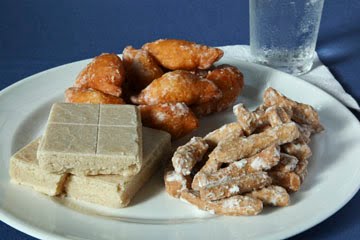
Some indian sweets comon in Trinidad


At this time of Devali, many Catholics in Trinidad partake of the Hindu foods and sweets. Some of these sweets are offered to idols. One particular sweet which cannot be purchased is Prasad. The word Prasad means "gracious gift" in Hindi and really is a gift offered to the god/godess. This food and others are then shared with all as a gift from their god. The prasad is considered to have the deity's blessing residing within it. So the blessing of prosperity is given to those who eat food offered to Lakshmi on Divali day.

Now how do we as Catholics reconcile ourselves to eating these foods. Well the bible gives us a clear reasoning in 1 Corinthians:
Now, concerning what you wrote about food offered to idols.


It is true, of course, that “all of us have knowledge,” as they say. Such knowledge, however, puffs a person up with pride; but love builds up. Those who think they know something really don't know as they ought to know. But the person who loves God is known by him.

So then, about eating the food offered to idols: we know that an idol stands for something that does not really exist; we know that there is only the one God. Even if there are so-called “gods,” whether in heaven or on earth, and even though there are many of these “gods” and “lords,”  yet there is for us only one God, the Father, who is the Creator of all things and for whom we live; and there is only one Lord, Jesus Christ, through whom all things were created and through whom we live.
But not everyone knows this truth. Some people have been so used to idols that to this day when they eat such food they still think of it as food that belongs to an idol; their conscience is weak, and they feel they are defiled by the food. Food, however, will not improve our relation with God; we shall not lose anything if we do not eat, nor shall we gain anything if we do eat.
Be careful, however, not to let your freedom of action make those who are weak in the faith fall into sin. Suppose a person whose conscience is weak in this matter sees you, who have so-called “knowledge,” eating in the temple of an idol; will not this encourage him to eat food offered to idols? And so this weak person, your brother for whom Christ died, will perish because of your “knowledge”! And in this way you will be sinning against Christ by sinning against other Christians and wounding their weak conscience. So then, if food makes a believer sin, I will never eat meat again, so as not to make a believer fall into sin.

Trinidad and Tobago Catholics in the Workplace Convention

Tuesday, 13 November 2012

shub devali

To all my Hindu Brothers and Sisters Shub Devali. (happy Diwali). The story of the Hindu gods are like the story of the Greek gods. Full of intrigue and Drama. Hindu's celebrate several events in the story of their gods in relation to Devali.
The killing of Narakasura: Celebrated as Naraka Chaturdashi, one day before Diwali, it commemorates the killing of the evil demon Narakasura, who wreaked havoc. Krishna's wife Satyabhama killed Narakasura during the Dwapara yuga. In another version of the belief, the demon was killed by Krishna or Krishna provoked his wife Satyabhama to kill Narshna, defeating Indradebated with the villagers about what their 'dharma' truly was. They were farmers, they should do their duty and concentrate on farming and protection of their cattle. He said that all human beings should do their 'karma' to the best of their ability and not pray for natural phenomenon. The villagers were convinced by Krishna, and did not proceed with the special puja (prayer). Indra was then angered, and flooded the village. Krishna lifted Mount Govardhan and held it up to protect the people and cattle from the rain. Indra finally accepted defeat and recognized Krishna as supreme. Although this aspect of Krishna's life is sometimes ignored it sets up the basis of the 'karma' philosophy later detailed in the Bhagavat Gita.
So the story is that Light overshadowed darkness. 

Today I have my indian sweets to eat and celebrate the power of Light over darkness.